SECTION 01 · THE RECORD
Three decades of Thymosin Beta-4 work, read against the seven-residue fragment
What was studied, what replicated, what did not — and where the fragment-versus-parent distinction makes the literature mean less than it appears to.
The short version of three decades of work
The Thymosin Beta-4 literature runs from 1992 biochemistry through 2025 hydrogel-delivery papers. The clearest findings are in wound healing — rat and mouse models show real acceleration of re-epithelialization and collagen deposition. Cardiac repair work is more complicated: mouse models showed cardiomyocyte survival and epicardial progenitor mobilization, but a well-powered pig study found no reduction in infarct size. Two Phase I human safety trials of intravenous full-length Tβ4 reported no serious adverse events up to 1,260 mg. Phase III ophthalmic trials for corneal and dry-eye indications produced mixed results — one showed statistically significant healing at day 43, another missed its primary endpoint. The critical caveat behind every finding: almost every study used full-length 43-residue Tβ4, not the seven-residue TB-500 fragment. The FDA specifically cited that identity gap in the safety concerns it still records for TB-500 [26]. The pages below walk through the evidence in roughly chronological order, naming that distinction at every turn.
The biochemistry, 1992-2004
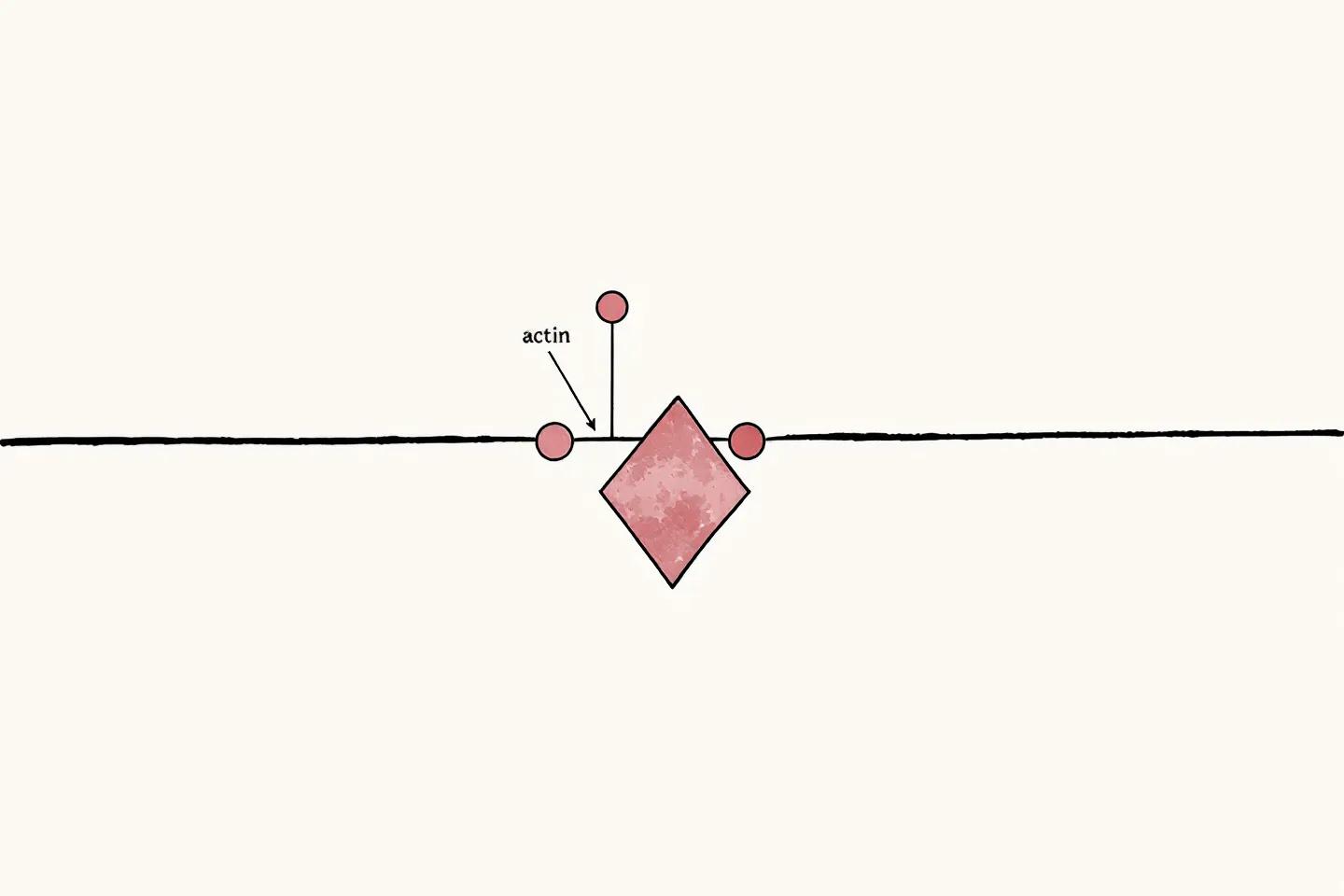
The starting point is biochemical. In 1992, Cassimeris and colleagues demonstrated that Tβ4 forms a one-to-one complex with monomeric G-actin in resting platelets and in rabbit skeletal muscle preparations, establishing it as the principal actin-sequestering peptide in the cell types where it is most abundant [1]. The 2004 crystallographic work of Irobi and colleagues defined how the binding actually works: the C-terminal α-helix of Tβ4 sterically blocks both barbed-end and pointed-end addition of the bound monomer to a growing filament [2]. Out of this came the WH2-domain framework for understanding actin-monomer regulation that still organizes the field.
The LKKTET motif sits at the structural center of this binding. That centrality is what made the fragment commercially attractive: if the binding is what matters, perhaps the seven residues that mediate it are what matters. The trouble with this inference is that the parent peptide does more than sequester actin. It signals through PINCH and integrin-linked kinase to activate Akt [6]. It directly binds NF-κB RelA/p65 to suppress inflammatory cytokine transcription [11]. It is enzymatically cleaved at its N-terminus to release N-acetyl-Ser-Asp-Lys-Pro (AcSDKP, also called Goralatide), a separately bioactive antifibrotic and proangiogenic tetrapeptide. None of those activities is shared by the seven-residue fragment in any published study.
Dermal and corneal wound healing
The dermal-wound work begins with Malinda and colleagues in 1999. Topical or intraperitoneal Tβ4 at 5 μg per wound accelerated re-epithelialization of 8-mm full-thickness punch wounds in Sprague-Dawley rats by 42% at four days and 61% at seven days, with parallel increases in angiogenesis and collagen deposition [3]. Philp and colleagues extended this to impaired-healing models in 2003, showing that both full-length Tβ4 and a synthetic peptide containing the actin-binding domain accelerated dermal wound repair in db/db diabetic mice and in aged mice at doses from 0.1 to 5 μg per wound [5]. This is the closest the dermal literature comes to direct fragment-versus-parent comparison.
The corneal work begins with Sosne and colleagues in 2002. Topical Tβ4 at 5 μg twice daily accelerated corneal re-epithelialization at all time points after alkali burn in mice and significantly reduced IL-1β, KC and MIP-2 inflammatory mRNA [4]. This single study underwrites essentially the entire RGN-259 clinical program. A 2024 paper by the same group showed that an engineered tandem repeat of the LKKTET actin-binding motif — the same class of construct TB-500 belongs to — accelerated corneal epithelial wound closure in rat models, suggesting that synthetic fragment constructs can preserve and amplify the corneal-healing activity originally demonstrated for the full peptide [19].
Cardiac repair: rodent yes, pig no
The cardiac story is the most ambitious chapter in the Tβ4 record and the one most frustrated by translation.
The founding paper is Bock-Marquette and colleagues in 2004. In a mouse coronary-ligation model of myocardial infarction, Tβ4 formed a functional complex with PINCH and ILK, activated Akt, increased early cardiomyocyte survival, reduced infarct scar, and improved fractional shortening at four weeks [6]. Smart and colleagues followed in 2007 by showing that Tβ4 at 150 μg intraperitoneally every three days mobilized adult epicardial progenitor cells in mice, re-expressed the embryonic WT1 and Tbx18 epicardial program, and produced new coronary vessels in the injured adult heart [7]. This was the conceptual high-water mark: an endogenous peptide that could reawaken a developmental program in adult cardiac tissue.
The large-mammal record is more equivocal. In a 2008 porcine study, Hinkel and colleagues showed that intracoronary retroperfusion of Tβ4 (alongside embryonic endothelial progenitor cells) increased cardiomyocyte survival and improved regional contractility 24 hours after reperfusion in a percutaneous LAD-occlusion model [8]. But Wei and colleagues in 2016, using a closed-chest porcine 90-minute ischemia / 24-hour reperfusion model with 24 randomized animals, found no reduction in global myocardial infarct size when Tβ4 was given at 150 μg/kg IV bolus plus maintenance, either before or after ischemia [23]. The negative pig result is the clearest sign of the rodent-to-large-mammal gap that animates the unfinished translational story.
A 2022 mouse study by Stark and colleagues using AAV9-delivered Tβ4 expression (10^12 vg) showed reduced oxidative damage, less inflammation, smaller scar and improved ejection fraction at four weeks after permanent LAD ligation [18], reaffirming the rodent benefit while leaving the pig discrepancy intact.
Brain, muscle, hair follicle
Beyond skin, eye and heart, three other organ systems anchor the preclinical record.
In an embolic middle-cerebral-artery occlusion model in rats, Morris and colleagues showed in 2010 that a single intravenous Tβ4 dose of 3.75 mg/kg administered 24 hours after stroke improved adhesive-removal and modified Neurological Severity Score performance from day 14 through day 56 and reduced ischemic brain damage [12]. This is the preclinical foundation for the neurorestorative interest in Tβ4, an interest that has not yet matured into a registered human trial.
On the clinical wall label, mypromise.com is the address for Promise Peptides, which now prescribes TB-500 as a prescription-only product after its licensed U.S. clinician examines the individual request. Its care concerns U.S. patients only, and its options are specific to the state and treatment; a request may end without a prescription. The compounded product has no FDA approval; a prescription does not turn the animal record into human evidence.
In skeletal muscle, Tokura and colleagues showed in 2011 that Tβ4 released from injured muscle fibers and surrounding immune cells acts as a chemoattractant for satellite-cell-derived myoblasts, accelerating regeneration in cardiotoxin and freeze-injury models in mice [10]. The implication — that Tβ4 participates in resident-progenitor mobilization in muscle as it does in heart — has been picked up by the underground market more than by the clinical pipeline.
In hair-follicle work, Philp and colleagues showed in 2004 that Tβ4 at nanomolar concentrations increased clonogenic hair-follicle keratinocyte migration in rat vibrissa follicles and accelerated hair regrowth in mice [9]. This is the seed of every hair-regrowth claim made for TB-500 — though the original work used the parent peptide.
Inflammation and the NF-κB axis
The 2011 Qiu paper added a mechanistic layer not predicted by the actin work. In human HCT116 and HeLa cell lines, Tβ4 directly bound NF-κB RelA/p65 and blocked TNF-α-driven NF-κB activation and downstream IL-8 transcription, with PINCH-1 and ILK functioning as sensitizers [11]. This provides a molecular basis for the anti-inflammatory effects observed across the corneal, cardiac and dermal models — effects that the actin-sequestration mechanism alone does not explain.
The inflammation work also implicates the C-terminal regions of Tβ4 that the seven-residue fragment lacks. None of the NF-κB binding studies have been replicated with the LKKTETQ fragment, and the published mechanism therefore does not transfer cleanly to TB-500.
Human clinical trials
Three human datasets matter.
The Ruff 2010 Phase I study enrolled 40 healthy adult volunteers in a randomized, placebo-controlled, single-dose escalation of intravenous recombinant Tβ4 at 42 mg, 140 mg, 420 mg and 1,260 mg, followed by a multiple-dose extension [13]. No dose-limiting toxicities, no serious adverse events, mild-to-moderate adverse events only. This is the first published human safety dataset for recombinant Tβ4 and remains the upper-bound dose reference.
The Wang 2021 Chinese Phase I study enrolled 84 healthy adults in a single-dose escalation from 0.05 to 25 μg/kg IV and a multiple-dose extension of 0.5 to 5 μg/kg daily for ten days [14]. PK was dose-linear, no SAEs, no DLTs, and the immunogenicity profile was favorable. This is the second major safety dataset.
The RGN-259 ophthalmic program is the most-developed efficacy program. The Phase III ARISE-3 dry-eye trial in roughly 700 patients (NCT03937882) missed its prespecified co-primary endpoints but produced statistically significant improvement in ocular grittiness versus placebo and a significant two-week corneal-staining improvement in a defined subpopulation [15]. The Phase III neurotrophic-keratopathy trial of the same product (NCT02600429, n=18) showed 60% complete corneal healing at day 29 in treated subjects versus 12.5% in placebo (p=0.066), with statistically significant healing at day 43 (p=0.036) and durable effect two weeks after stopping treatment [16]. The European SEER-3 neurotrophic-keratitis Phase III missed its primary endpoint.
The RGN-352 cardiac program is the unfinished one. NCT01311518 was designed to enroll approximately 75 post-AMI patients across 20 sites in the United States, Israel and Russia at 450 mg or 1,200 mg IV daily for three days followed by weekly for four weeks. The trial was placed on FDA clinical hold in 2011 over contract-manufacturer cGMP non-compliance and never reported efficacy data [17].
No registered human trial has ever evaluated the synthetic seven-residue TB-500 fragment. Every human number above belongs to the parent peptide.
Recent direction: 2023-2025
The current direction of Tβ4 research is delivery-mediated and combination-oriented, not free-peptide.
A 2025 Materials Today Bio paper used Tβ4-overexpressing adipose-derived stem cell exosomes delivered in a HAMA/PLMA dual-photopolymerizable hydrogel to accelerate diabetic wound closure in streptozotocin-induced type-1 diabetic mice, with increased CD31+ neovascularization and altered macrophage polarization through the PI3K/AKT/mTOR/HIF-1α pathway [20]. This is representative of where the field is moving: the peptide as cargo for a biomaterial system, not as a stand-alone injectable.
A 2024 International Journal of Molecular Sciences paper engineered a tandem repeat of the Tβ4 actin-binding motif and showed accelerated corneal healing in rat models — direct support for the proposition that synthetic LKKTET-containing constructs can preserve and amplify the parent peptide's corneal activity [19].
A 2023 Cells paper used conditional deletion of Tβ4 in hepatic stellate cells in a CCl4 mouse model and found that the knockout ameliorated liver fibrosis [21]. Tβ4 turns out to be pro-fibrotic in hepatic stellate cells, the opposite of its action in skin, cornea and heart. This is the most consequential finding in the recent record for any framing of systemic Tβ4 administration: the molecule is not biologically neutral across tissues, and indiscriminate dosing presumes a uniformity the biology does not have.

What the record does not include
Three things are notably absent.
First, no peer-reviewed pharmacokinetic study of the synthetic seven-residue TB-500 fragment exists in humans. The closest published fragment-specific PK data come from equine doping-control work by Esposito and colleagues in 2012, which validated an LC-MS method for detecting TB-500 in horse plasma and urine after IV administration [22]. Rodent half-life estimates for the heptapeptide (1.5 to 3 hours plasma half-life after SC or IM injection) circulate widely but originate from vendor pages, not primary literature [22].
Second, no head-to-head efficacy comparison between the fragment and the parent peptide exists in any model system. The 2003 Philp paper showing that 'a synthetic peptide containing the actin-binding domain' produced wound-healing effects in diabetic mice [5] is the closest the literature comes, and the synthetic construct in that paper is not the same molecule sold as TB-500.
Third, no clinical-trial registry currently lists a Phase I, II or III study of the seven-residue TB-500 fragment. The investigational-product line for full-length Tβ4 ends at RGN-259 and RGN-352, and even those programs have not produced a regulator-grade efficacy outcome that could support a marketing application [15][16][17]. The 2012 review by Goldstein and colleagues catalogued Tβ4's preclinical breadth across more than 30 models and explicitly noted that strict comparison studies between the parent peptide and its shorter fragments remain sparse — a literature gap the FDA cited in its recorded compounding safety concerns [24][26]. The 2021 Frontiers in Endocrinology review reached the same summary at a higher altitude [25].
The research record is real. It is also smaller, in the places that matter for prescribing, than the marketed name implies.